
CCT Specialization Course
MANDALA & HEALING CIRCLES
The Contemplative Circle Method (CCM)
SPRING: APR 08 - 29, 2026 from 4.00 PM to 6.00 PM EST
This course is presented online with Zoom + Google Course
Participants receive the link and information 1 week before the program starts.
The ‘Mandala and Healing Circles’ is a four-week course that introduces participants to the historical, cross-cultural, and therapeutic foundations of mandala and circle-based practices. Rooted in the Contemplative Creative Therapy (CCT) model, this training explores how circular forms—whether symbolic, artistic, or ritual—can foster regulation, reflection, and transformation in clinical and community contexts.
Through an integration of contemplative psychology, creative arts therapy, and cross-cultural inquiry, participants learn to apply circle-based approaches as assessments, interventions, and meditations, as well as contemplative creative practices that support emotional regulation, trauma integration, and relational healing. The course also cultivates the experiential understanding of the circle as both an artistic process and a field of awareness that unites body, mind, and environment.
At The Lojong Center, these cross-cultural and interdisciplinary insights have been developed into the Contemplative Circle Method (CCM), a framework that combines contemplative presence, creative exploration, and clinical application. The method provides clinicians and facilitators with a way to integrate the timeless wisdom of mandalas and sacred circles with evidence-informed therapeutic approaches, thereby cultivating both personal insight and collective healing.


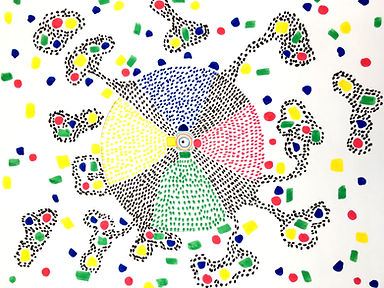
Course Overview:
A 4-module online course that explores the origins and contemporary applications of mandala and healing circles as pathways to integration, resilience, and collective healing. Drawing from cross-cultural traditions and contemplative psychology, it examines how sacred forms and communal practices can be adapted for therapeutic and educational contexts. The course culminates in the introduction of the Contemplative Circle Method (CCM), developed at The Lojong Center, which brings together contemplative presence, creative expression, and clinical practice.
This course is presented online with Zoom.
Participants receive the link and information 1 week before the program starts.
Purpose of the Course
This course introduces the origins and evolution of mandala and healing circles across cultures and traditions, examining their role in spiritual, artistic, and therapeutic contexts. Participants will explore how these forms of collective and contemplative practice support healing, meaning-making, and integration. At The Lojong Center, these insights converge into the Contemplative Circle Method (CCM), a contemporary framework for clinical and community settings.
Participants will gain insight into:
-
The symbolic, spiritual, and cultural significance of sacred circles and mandalas.
-
How contemplative circle-based methods foster safety, belonging, and transformation.
-
Practical approaches for integrating mandala and circle-based practices into clinical and community practice.
-
The foundations of the Contemplative Circle Method (CCM).
Module 1 - Origins and Contemplative Foundations of Mandala & Sacred Circles
Learning outcomes
· Understand the historical and psychological meanings of the mandala and circle archetype.
· Recognize how circle-based forms support containment, safety, and reflection in therapy.
· Identify links between ancient ritual circles and contemporary contemplative creative practices.
Module 2 - Circle-Based Practices in Psychotherapy and Mental Health
Learning outcomes
· Explain how mandala and circle-based practices can be integrated into psychotherapy and mental health settings
· Understand the cross-cultural foundations of mandala practices and integrate them in a culturally sensitive and ethically grounded way within mental health and psychotherapy contexts
· Explain how mandala and circle-based practices support psychological processes in psychotherapy and art therapy, including emotional regulation, self-awareness, and symbolic expression
Module 3 – The Mandala Model of Self and The Contemplative Circle Method (CCM)
Learning outcomes
· Describe the mandala model of Self, including the relationship between awareness (Self), ego constructions, and environmental influences
· Understand the theoretical foundations of the Contemplative Circle Method (CCM) as an extension of CCT
· Use the circle as a contemplative map to explore internal experience and support reflective awareness in clinical work
Module 4 - The Contemplative Circle Method: Clinical Application and Practice
Learning outcomes
· Understand the theoretical foundations, approach, and method of the Contemplative Circle Method (CCM), including its relationship to the CCT model and the use of the circle as a contemplative container
· Apply the contemplative creative process in CCM, including the use of feeling, observation, and questioning to support awareness, insight, and integration within the circle
· Adapt CCM practices to clinical populations and contexts, using a non-interpretive, attuned, and trauma-sensitive therapeutic stance to support emotional regulation and therapeutic exploration
Designed for:
This course is designed for mental health professionals, art therapists, psychotherapists, and contemplative practitioners who wish to integrate circle-based contemplative creative methods into their clinical or educational work. It is particularly suited for practitioners interested in contemplative science, Buddhist psychology, and integrative approaches that bridge creativity, embodiment, and mindfulness within therapeutic or community contexts.
Professionals from related disciplines—such as psychology, social work, counselling, somatic therapy, expressive arts therapy, and education—are also welcome to participate. Previous artistic experience is not required; an openness to contemplative exploration and reflective practice is encouraged.
For this online course, prior meditation experience or completion of the foundational training in Contemplative Creative Therapy (CCT) is recommended, as the material builds on core contemplative and creative principles.